Evidence Literacy
What a Systematic Review Does—and Does Not—Tell You About a Supplement
A systematic review can be powerful evidence, but only for the population, intervention, outcome, and level of certainty it actually covers.
Evidence Literacy
“Systematic review” is often treated as shorthand for a universal verdict. It is not. A well-conducted review can be highly useful, but its conclusion is bounded by the question it asked, the studies it found, the outcomes it examined, and the certainty of the resulting evidence.
That matters especially in supplement research, where a familiar ingredient may appear in different doses, forms, populations, comparison groups, and study durations. A review may give a strong answer to one narrow question while leaving several neighboring questions open.
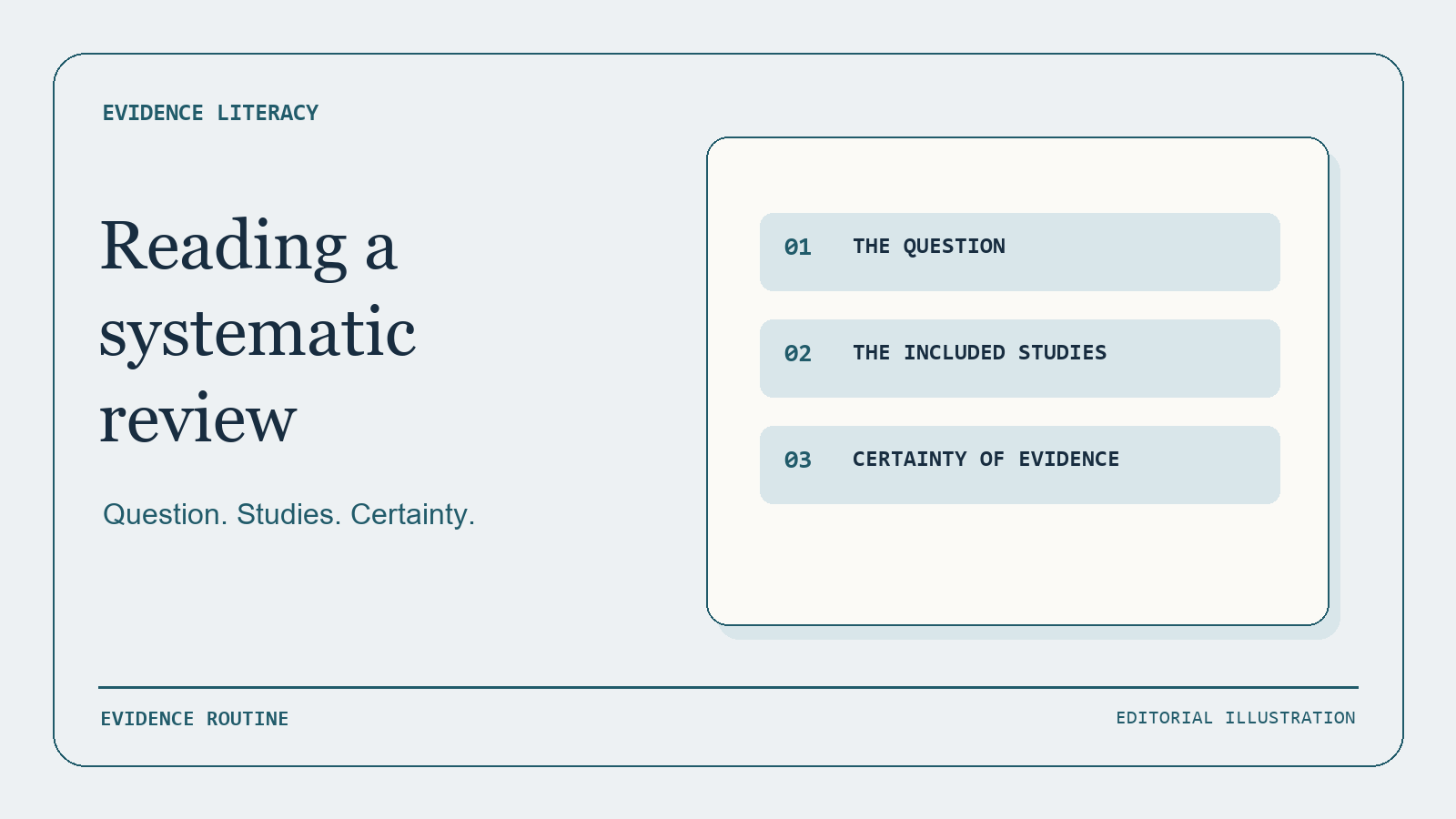
1. Start with the review question
Before interpreting a headline, identify the population, intervention, comparator, and outcome. A conclusion in healthy adults is not automatically a conclusion in people with a specific condition. A result for one dose or formulation is not automatically a result for every version of an ingredient. And a finding about a laboratory marker is not necessarily a finding about a participant-important outcome.
2. Check what was actually included
A systematic search does not guarantee that there are many informative studies to combine. Read the number of trials and participants, the dates searched, and the eligibility rules. A review of randomized trials may provide a different kind of evidence from a review that also includes observational studies. Neither approach erases the limits of the underlying studies.
3. Separate the estimate from its certainty
The pooled estimate is the review’s best numerical summary of the included studies. Its certainty asks a different question: how much confidence should readers place in that estimate? Cochrane guidance distinguishes imprecision—random uncertainty that can produce a wide confidence interval—from risk of bias, which concerns systematic error in study design or conduct. One cannot substitute for the other.
A result described as “not statistically significant” is not automatically proof that an effect is absent. It may instead mean that the available evidence cannot distinguish a meaningful benefit, a meaningful harm, and little or no effect with enough precision. The width and location of the confidence interval help explain which interpretation is justified.
4. Look for inconsistency and indirectness
Studies can differ in ways that matter: who took part, the supplement form and amount, follow-up time, comparator, and outcome measurement. When those differences are large, an average result can be less directly applicable to a specific real-world question. Consistent results from several rigorous studies can increase confidence; agreement alone does not resolve shared design limitations.
5. Translate the conclusion carefully
A careful reader can usually restate a review in one sentence: “For this population, using this intervention, the included studies provide this level of certainty about this outcome.” If that sentence becomes much broader when repeated in marketing or conversation, important context may have been lost.
This framework does not decide whether any person should use a supplement. It helps readers distinguish what a particular body of evidence supports from what remains uncertain.
Sources
Cochrane explains that bias and imprecision are distinct concepts in evidence appraisal, and its communication guidance advises placing certainty close to the finding rather than treating all review results as equally definitive.