Evidence Literacy
What a Confidence Interval Adds to a Supplement Headline
A confidence interval does not make a result true or false. It shows how much uncertainty remains around an estimate.
Supplement research is often reduced to a binary headline: a study "worked" or it "did not work." A confidence interval offers a more useful question: given the data collected, how precise is the estimated result?
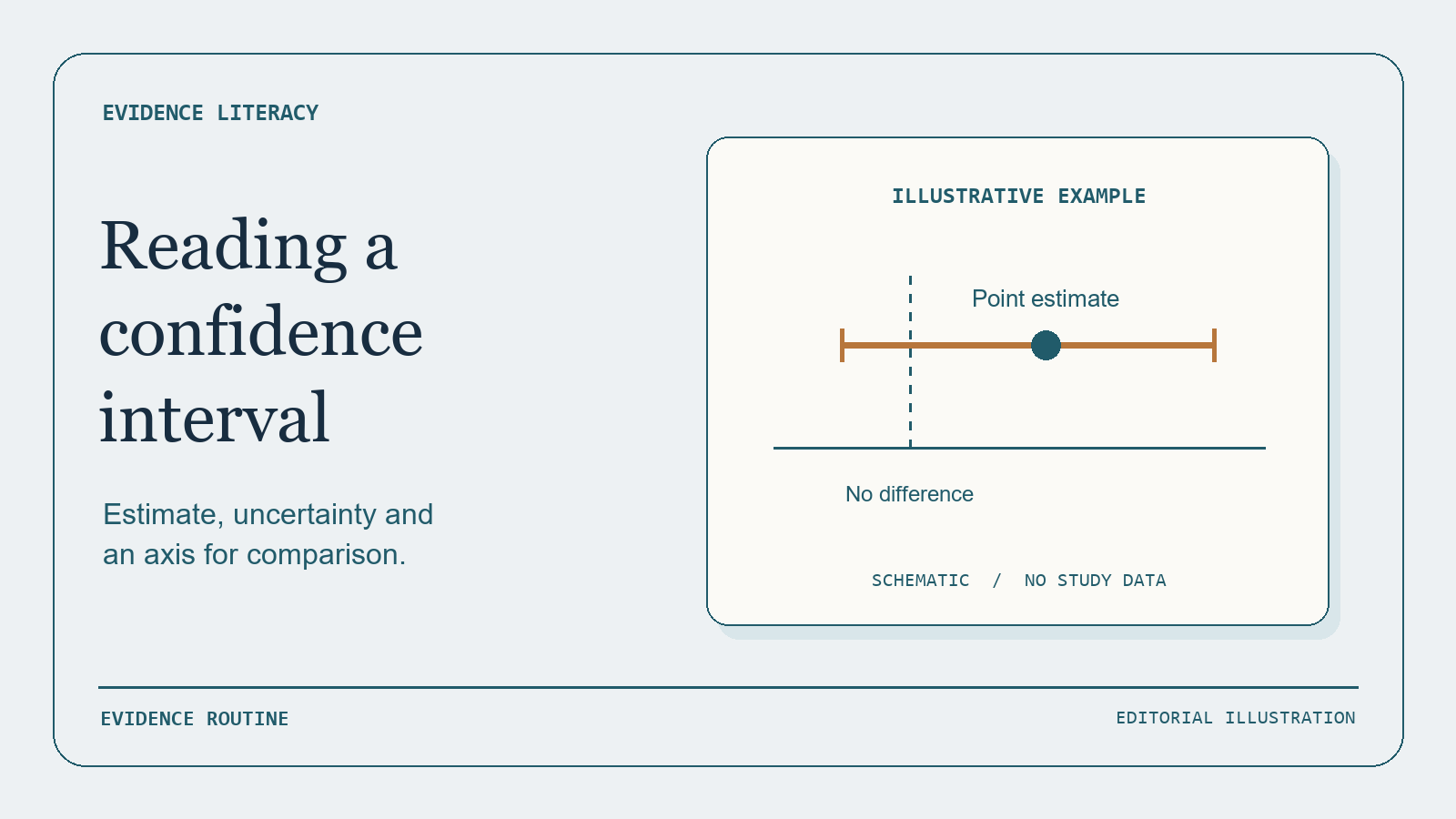
A confidence interval is a range placed around an estimate, such as a difference between groups or a risk ratio. It does not describe every possible future result, and it does not automatically prove a benefit. It shows the range of values that remain reasonably compatible with the study data under the method used.
Start with the estimate, not the star
Suppose a trial reports that one group changed by a little more than another group. The point estimate is the study's single best estimate of that difference. The confidence interval tells the reader how tightly—or loosely—the data surround it.
A narrow interval suggests more precision than a wide one. But precision is not the same as practical importance. A very precise estimate can still be too small to matter in real life. Conversely, a wide interval can include effects that would matter as well as effects that would not, which means the study leaves more uncertainty unresolved.
Why the null value gets attention
For some measures, an interval that includes the "no difference" value is commonly described as not statistically significant. For a difference in averages, that reference value is usually zero. For a ratio, such as a risk ratio, it is usually one.
That convention is easy to overread. An interval that crosses the null value does not establish that a supplement has no effect. It says the study's estimate is compatible with no difference and with some other values in the displayed range. The width of that range is the important part of the story.
Three questions worth asking
- What outcome was estimated? A confidence interval around a laboratory measure is not automatically evidence about symptoms, daily function, or long-term health.
- How wide is the interval? Look at the full range, not only whether it crosses a threshold.
- Would the values in that range be meaningful? Statistical precision and practical relevance are separate questions.
One study is rarely the final word
Cochrane's methodological guidance notes that confidence intervals communicate uncertainty around summary estimates, while variation between studies and potential bias still need separate consideration. A pooled result can be informative, but it can also mislead if different populations, doses, formulations, outcomes, or study designs are combined without care.
Online summaries frequently omit these details. NCCIH advises readers to identify who created health information, where the information came from, and whether it is current and commercial. Reading the linked study or review helps restore the context a headline leaves out.
A calmer conclusion
Confidence intervals are not a badge of certainty. They are a reminder that a numerical result comes with a margin of uncertainty. A careful interpretation keeps the estimate, the range, the outcome, and the limitations together—and avoids turning one study into a personal medical recommendation.