New Research
In a Crossover Trial, DHA Changed Several Short-Term Responses to a High-Fat Breakfast
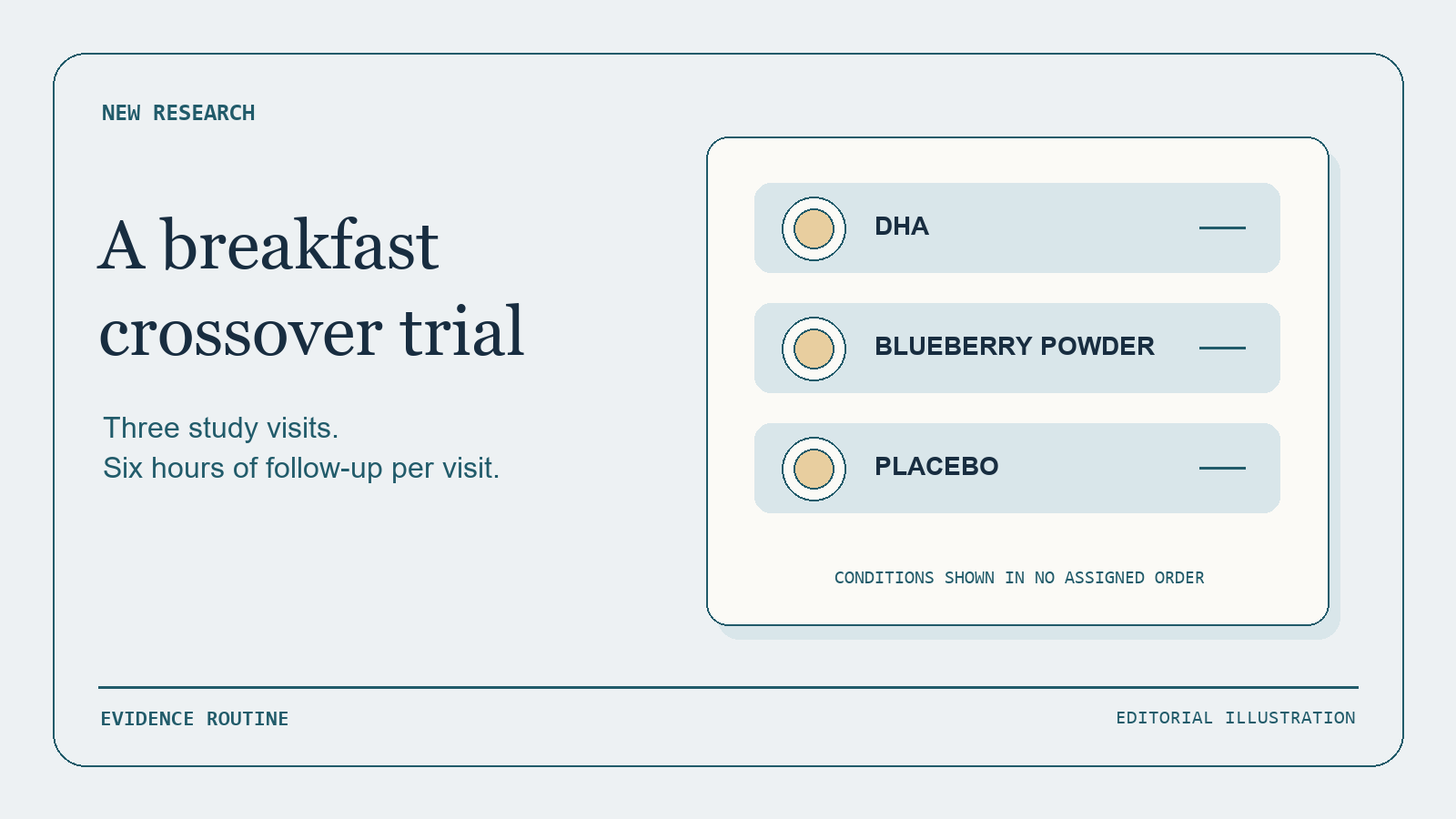
A randomized crossover study in 62 healthy adults compared 1.76 g DHA, blueberry powder, and placebo with a standardized high-fat breakfast. Its measurements were short-term biomarkers, not clinical outcomes.
Published October 2026. Source: Huang et al., Nutrition Research.
A randomized, double-blind crossover study examined short-term responses to a standardized high-fat breakfast in 62 healthy adults. On separate study visits, participants received the meal with either 1.76 g of DHA, blueberry powder, or placebo; blood and vascular-function measurements were collected for six hours afterward.
What the study measured
The researchers focused on post-meal laboratory and physiological measures: inflammatory signaling in blood samples, cytokine production, lipid measures, and reactive hyperemia index, a noninvasive marker of endothelial function. This was not a study of long-term health outcomes.
What the researchers reported
Relative to placebo, the DHA condition was associated with lower values for several measured inflammatory responses after the meal. It was also associated with a higher reactive hyperemia index at six hours. The blueberry-powder condition affected one of the reported blood-response measures, but the study did not report the same placebo-adjusted endothelial-function result for blueberry powder.
How to read the result
The crossover design is a strength: participants served as their own comparison across the study conditions. But the trial was short, involved healthy adults with a mean age of about 27 years, and examined responses after one controlled breakfast. These findings cannot establish that DHA prevents disease, improves long-term vascular health, or produces the same effects in other populations or diets.
The dose also matters for interpretation. The DHA condition supplied 1.76 g in a controlled research setting; the result should not be treated as a personal dosing rule or as evidence about every omega-3 product.
Bottom line
This study adds a focused example of how a specific DHA dose influenced selected post-meal biomarkers under controlled conditions. It is useful evidence about a short-term physiological experiment, not a treatment claim or a product recommendation.